
Wednesday, September 8, 2010
Math Book Purse
I couldn't help myself—I made a math book into a purse. One of my favorite college textbooks was Advanced Engineering Mathematics by Erwin Kreyszig; the artwork on the cover looked like it was drawn by hand so I kept the book. Much to the dismay of my husband, also a retired mathematics professor, I cut out the text block and made the book covers into a purse. To make this transition a little easier for him, I lined the purse with fabric with circles and made a little pocket for my circular slide rule, also from my college days. I bought a circular slide rule so that I could carry it in my purse in the 60's; the long slide rules didn't fit.
 This photo was taken opening night of Arts Alive. The book arts guild I belong to, North Redwoods Book Arts Guild, was having an exhibition of about 50 handcrafted books at Eureka Books. People loved the book purse but it wasn't for sale as it is truly one-of-a-kind. However, I have an old Nancy Drew book.....


Wednesday, September 1, 2010
Done With My ABC's
My book is finally completed. I still see places where I could do some more sewing, but I'm done. I am pleased and it feels good when you read it. It will be in the North Redwoods Book Arts Guild exhibition at Eureka Books during Arts Alive. The opening is Saturday, September 4, 6pm-9pm and will be on display throughout the month. (All photos by Ellen)
 I also have one pair of book earrings. The casebound books include twenty pages of pithy quotes about books.

Another has wooden covers (redwood) with a leather spine, Japanese stab binding and my photography. It features Chumash Indian art from the Painted Cave Historic Park outside of Santa Barbara.
 Finally, I have a canvas and fabric book with my photos of rural Nebraska. The canvas is painted with acrylics, photos printed on fabric, and all printed fabrics came from my mother-in-law's quilt stash.
The clothes pin and key came from the 300 Mile Junk Jaunt in Central Nebraska.


Another has wooden covers (redwood) with a leather spine, Japanese stab binding and my photography. It features Chumash Indian art from the Painted Cave Historic Park outside of Santa Barbara.

The clothes pin and key came from the 300 Mile Junk Jaunt in Central Nebraska.


Wednesday, August 25, 2010
ABC Book of Machine Embroidery
I don't even know why I started this project. I love fabric, used to sew a lot of my clothes, and have made a few small quilts. I also subscribe to The Quilting Arts Magazine where I find more ideas for surface treatment for the pages of my handcrafted books than I do in magazines about books or paper arts. I frequently visit Lincoln, Nebraska, home of the International Quilt Museum, and I also like to visit small, boutique quilt shops. In one such shop I found a fabulous encyclopedia of machine embroidery, printed in England and featuring those wonderfully creative English textile artists. As a challenge, I decided to create 26 embroidered trading cards representing one letter of the alphabet: A is for applique, B is for bullion stitch, C is for couching stitch, etc. Now, several years later, it occurred to me that I could use these cards to create a fabric accordion book. I'm not finished (I don't know why I thought this would be quick) but here is the progress so far.
 I just love this old Bernina, she is a real workhorse. Purchased in 1975 it is my newest of four machines. I have a really old treadle machine of my great-aunt's, a 1928 Singer in a beautiful wooden "coffin" case with every attachment you can imagine, and a 1960's Polish sewing machine used in home economics classes in Palmer High School (Nebraska). I am using the Bernina because it is the only one with drop feed. I am quilting a long strip of my hand dyed fabric which will be used for the front side of the accordion structure.The process is repeated for the back of the structure.
 The trading cards are spaced out on the strip and sewn onto the quilted backing.
 Letters of the alphabet are then sewn on. OK. G stands for what?
 I really like the "V is for vermicelli" stitch. I have finished both sides of the book and will attach the front and back strips along the top, insert buckram in between (creates the rigidity needed for the book) and will machine embroider around all four sides. The valleys and folds will be stitched before folding. I used my pigment-based inkjet printer to print the text on on my hand dyed fabrics, prepared with Bubble Jet 2000. I think I could sew in my sleep.


Sunday, August 22, 2010
St. Petersburg, Russia
I'm a bit late with this post! I haven't really quit traveling since coming home from Norway, Sweden, Finland, and Russia in late June. I couldn't move into the present until I posted a few photos of St. Petersburg, one of the most interesting cities I've ever visited. While there I read a wonderful memoir of Elena Gorokhova's childhood in Cold War Leningrad, called A Mountain of Crumbs. Leningrad has changed more than its name since Elena's time—there are bustling markets, luxury shops, a multitude of expensive cars and lots of tourists. The Soviet parts of the city triggered my "Tommy Turtle" response; training we elementary school students endured during the Cold War. The other reaction I had was of the extreme wealth of the Czars combined with the knowledge of the extreme poverty of the serfs.
 Czar Nicholas and Alexandra's remains have been located and moved to Saints Peter and Paul Fortress Cathedral. Another good book is Nicholas and Alexandra, by Robert Massie.
 Peterhof, the Summer Palace created by Peter the Great to compete with Versailles. The incredible fountains were the beginning of the study of hydraulic engineering.
 Golden domes of the family church (hardly seems like the right word) of Peterhof. We didn't even go inside of this. Every room in the palace was decorated differently and packed with exquisite artwork and furniture.
 Another favorite dome, The Church of the Spilled Blood (another czar meets unfortunate end).
 So much gold in all of the cathedrals and palaces. This is not a miniature.


Rollie and I with the remarkable Hermitage behind us. These buildings are only a fraction of the entire line of buildings created by Catherine the Great to house one of the greatest art collections in the world.
This dog has had some training and didn't even flinch when people tossed coins into her begging bucket. She was really bringing in the money. Yes, we couldn't help ourselves.
Friday, July 16, 2010
Moving Back in Time
The Museum of Contemporary Art in Helsinki, Finland, encourages the viewer to interact with the art. My friends and I came upon this fascinating room with strips of plastic hanging from the ceiling. One step inside and you could not see where you were going and just had to move through, trusting that you would eventually come out. I thought it would be fun to take a little video with my camera as Barb entered from the left. Little did I know that it would have a surprise ending.
Wednesday, June 30, 2010
Paints for a 17th Century Warship, The Vasa

17th Century Swedish Warship, Vasa
My favorite stop in Stockholm was the museum that housed the restored Swedish warship, The Vasa. It sank as it sailed out of the harbor on it's maiden voyage, August 10, 1628. The crowds were there to see it off, its guns were ready to fire in celebration, and seas were fairly calm. However, the ship didn't have enough ballast and a slight wind was disastrous; it sank 350 feet from shore. The picture above (taken by my husband) shows the Vasa in its unpainted state. To read about the early attempts to raise the ship and the details of the final recovery in 1961 or to view a fabulous photo of a painted scale model, Wikipedia has an excellent article.


Restorers used chemical analysis to determine the pigments used to paint the ship and the figure above have been painted to show the wide range of vivid colors.

Look at these pigments! Imagine a warship, built to intimidate the enemy, painted in these colors. The colors on each shelf are (L to R):
- Mountain Blue (from the azurite stone to its left), Orpiment (a sulfide of arsenic), Mountain Green (from the malachite to its left), and Iron Oxide Red (from the hematite to its left).
- Cinnabar (cinnabar rock to its right), Red Ochre, Light Yellow Ochre, Yellow Ochre (last three are iron oxides).
- Ivory Black (from roasted elephant tusks), Lamp Black (yes, carbon from soot), Madder Root (a plant native to Greece), Alizarin (from Madder), Ground Brazil Wood (used by Van Gogh), and Indigo.
- The lowest shelf is labeled "Artificial Pigments" and they are (if I'm reading these correctly) Yellow, Lead White, Red Lead, Cobalt, Senalt.

The first is Color, The Story of Dyes and Pigments by Delamare and Guineau.

The second is Artist's Color Manual by Simon Jennings.
I'll never look at watercolor or acrylic paints in quite the same way again. Fortunately, we have found other ways to create Ivory Black.
Wednesday, June 16, 2010
My Artistic Cousin in Norway
I found my Norwegian cousins over eight years ago using information from an old box of photos I inherited from my great-aunts. It took some academic research (translating letters and writing on the back of photos, online genealogy, and microfilm of Lutheran church records and census data) but ultimately it was a search of email addresses that gave me the one name that might be a cousin: Bjorn Folkmann. Looking for relatives named Olsen would have been hopeless, but this name I recognized from old photos. Bjorn didn't even know he had American cousins and had to ask his mother about our common great-grandfather, Gustav Olsen. Bjorn then put me in touch with Elsie and her daughters, Merete and Barbro. Bjorn is a statistician, which I found amusing and I've enjoyed meeting him. Elsie is close to my age and is a weaving artist. She has two Swedish looms and creates intricate wall hangings as well as rugs for her beautiful wooden floors. Here are some samples of her work.
.


.


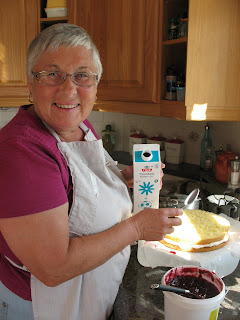
She is also a great cook and likes to make desserts as much as I do.
Cream cake with marzipan cover.
Subscribe to:
Posts (Atom)